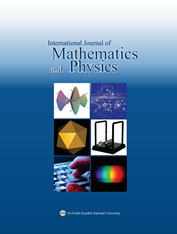
Editor-in-Chief
Kuantay Boshkayev
Associate Editor
Nazgul Kaliyeva
Executive Editor
Aiganym Sarsembayeva
Roza Sabirova
Print ISSN 2218-7987
Online ISSN 2409-5508
Publisher
Al-Farabi Kazakh National University
farabi.university

The International Journal of Mathematics and Physics (IJMPH) is published by Al-Farabi Kazakh National University. The journal is committed to maintaining the highest standards of scientific integrity, transparency, and editorial excellence. These policies apply to authors, reviewers, editors, and Editorial Board members.
1. Editorial Oversight and Decision Making
The Editor-in-Chief oversees the scientific quality, integrity, and editorial direction of the journal. Editorial decisions are based solely on scientific merit, originality, relevance, and compliance with journal standards.
Editors evaluate manuscripts impartially and without regard to race, gender, nationality, political views, institutional affiliation, or commercial considerations.
The final decision to publish rests with the Editor-in-Chief based on peer-review reports and journal criteria.
2. Authorship
Criteria for Authorship
Authorship should be limited to individuals who have made significant intellectual contributions to the research and manuscript preparation. An author must have contributed substantially to at least one of the following aspects:
• Conceptualization or design of the study
• Data collection, analysis, or interpretation
• Development of theoretical framework or methodology
• Drafting or critical revision of the manuscript
All authors must approve the final version of the manuscript prior to submission and agree to be accountable for the accuracy and integrity of the work.
Individuals who contributed to the research but do not meet the criteria for authorship should be acknowledged appropriately in the Acknowledgments section.
Artificial intelligence tools. AI-based writing tools cannot be listed as authors. Their use must be disclosed in the Acknowledgments section. Authors remain fully responsible for the content of the manuscript.
Contact emails. Active email addresses are required for all authors at submission to ensure proper communication during peer review. In the case of large collaborations, a designated Collaboration Representative email address may be provided.
Authorship Changes
Requests to add, remove, or reorder authors after submission must be submitted by the Corresponding Author and must include:
• A clear justification for the change
• Written confirmation of agreement from all listed authors, including any added or removed authors
Authorship changes will not be permitted after acceptance of the manuscript, except in exceptional circumstances approved by the Editor-in-Chief.
Responsibilities of Authors
All authors share collective responsibility for the content of the published work.
The Corresponding Author is responsible for:
• Ensuring that all eligible contributors are listed as authors
• Confirming that all authors have reviewed and approved the manuscript
• Managing communication with the editorial office during peer review
• Ensuring compliance with journal policies
By submitting a manuscript, the Corresponding Author certifies that:
• The manuscript represents the original work of the listed authors.
• The results are accurate and honestly reported.
• All listed authors made significant contributions and approve the submission.
• No eligible contributor has been omitted from authorship.
• The manuscript is not under consideration elsewhere and has not been previously published.
• Relevant related or prior submissions have been disclosed to the editors.
• The authors agree to comply with IJMPH editorial policies and procedures.
• Supporting data exist and can be provided upon reasonable request.
Post-publication contact author(s). One or more authors may provide their email address in the published article to serve as a contact point for readers and researchers. The Contact Author does not have to be the Corresponding Author.
Author contributions. All authors must be able to clearly identify their specific contributions to the work. IJMPH encourages authors to describe individual contributions using the CRediT (Contributor Role Taxonomy).
Author Affiliations
Authors must list the institutional affiliation(s) where the research was conducted.
Use of ORCID iDs
ORCID digital identifiers help ensure accurate attribution of authorship and maintain a persistent link between researchers and their scholarly work throughout their careers.
IJMPH requires the Corresponding Author to provide a valid ORCID iD at the time of submission. All co-authors are strongly encouraged to register for and provide an ORCID iD.
Authors may be asked to confirm their ORCID identifier during the submission process. Providing verified ORCID iDs supports transparency, improves discoverability of published research, and reduces ambiguity in author identification.
ORCID iDs may be added after acceptance; however, this may result in delays in the production process.
3. Submissions, Resubmissions, and Publication Terms
Manuscripts must be submitted through the journal’s official OJS (Open Journal Systems) online submission platform.
For detailed information on manuscript preparation, formatting requirements, and submission procedures, please refer to the Information for Authors section of IJMPH.
Receipt Dates and Revised Dates
The receipt date of a manuscript corresponds to the date on which it is successfully submitted through the journal’s electronic platform. This date is recorded in the journal’s system and may appear in the published article.
If substantial revisions are made during peer review, the revised submission date may also be indicated in the publication record. In cases of major restructuring or extended delays, a manuscript may be assigned a new submission date at the discretion of the editors.
Relation to Prior Materials
IJMPH considers only original manuscripts that have not been published previously and are not under consideration by another journal.
Manuscripts based on theses, dissertations, or conference presentations may be considered, provided that the submission represents a significantly expanded and original scholarly work.
Authors must disclose any related manuscripts, including prior submissions, preprints, or closely related publications, at the time of submission.
Reproduction of previously published figures, tables, or text must be clearly cited and comply with applicable copyright and licensing requirements. Authors are responsible for obtaining any necessary permissions.
References to Other Work
Authors are expected to provide accurate and comprehensive references that appropriately acknowledge prior research relevant to the submitted work.
References should:
• Reflect significant contributions in the field;
• Be current and relevant at the time of submission;
• Avoid excessive self-citation;
• Avoid manipulation of citation metrics.
Failure to properly acknowledge prior work may result in delays in review or rejection.
Supplemental Material
Authors may submit supplementary materials that support the main findings of the manuscript. Such materials may include datasets, computational details, additional figures, multimedia files, or extended methodological descriptions.
Supplemental materials should enhance transparency and reproducibility but should not replace essential information required to understand the main text.
All supplemental content is subject to editorial review and must meet the journal’s standards for clarity, relevance, and integrity.
4. Peer Review
Purpose of Peer Review
Peer review is central to maintaining the scientific quality and integrity of IJMPH. The review process ensures that submitted manuscripts meet the journal’s standards of originality, methodological rigor, clarity of presentation, and relevance to mathematics and physics.
Peer review also provides constructive feedback to authors to improve the quality of their work.
Peer Review Procedure
IJMPH applies a double-blind peer review model.
After initial editorial screening for scope, formatting compliance, and plagiarism detection, suitable manuscripts are sent to at least two independent reviewers with relevant academic expertise.
Reviewers evaluate the manuscript based on:
• Scientific significance and originality;
• Theoretical or methodological soundness;
• Clarity and structure;
• Appropriateness of references.
Based on the reviewers’ reports, the editor may decide to:
• Accept the manuscript;
• Request minor or major revisions;
• Reject the manuscript.
If reviewer opinions conflict, a third reviewer or Editorial Board member may be consulted.
The final decision rests with the Editor-in-Chief or executive editor.
Selecting Peer Reviewers
Reviewers are selected based on subject expertise, academic qualifications, and research experience relevant to the submitted manuscript.
Authors may suggest potential reviewers and may identify individuals with whom a conflict of interest exists. However, the final selection of reviewers remains at the discretion of the editors.
Reviewers must disclose any potential conflicts of interest and decline review if impartial evaluation cannot be ensured.
Confidentiality of Peer Review Materials
All materials related to the peer review process are treated as confidential.
Reviewers must not:
• Share manuscripts with third parties without permission;
• Use unpublished information for personal research or advantage;
• Disclose their identity unless agreed by the journal.
Editors likewise maintain confidentiality of reviewer identities and manuscript content throughout the evaluation process.
Appeals
Authors who believe that an editorial decision was made in error may submit a formal appeal.
An appeal must:
• Be submitted in writing to the editorial office;
• Clearly explain the scientific grounds for reconsideration;
• Address the comments provided in the decision letter.
Appeals are evaluated by the Editor-in-Chief and, where appropriate, by a member of the Editorial Board who was not involved in the original decision. The decision of the Editor-in-Chief is final and not subject to further appeal.
5. Ethics and Research Integrity
The International Journal of Mathematics and Physics (IJMPH) is committed to maintaining the highest standards of publication ethics and scientific integrity. The journal follows internationally recognized ethical principles and aligns its practices with COPE standards and the ethical regulations of Al-Farabi Kazakh National University.
All participants in the publication process – authors, editors, reviewers, and members of the Editorial Board – are expected to comply with these standards.
Ethics and Conduct Responsibilities of Editors and Reviewers
Editors and reviewers must act with fairness, objectivity, and confidentiality throughout the editorial process.
Editors are responsible for:
• Making publication decisions based solely on scientific merit;
• Ensuring impartial and unbiased evaluation;
• Protecting the confidentiality of submitted manuscripts;
• Addressing ethical concerns in a timely manner.
Reviewers must:
• Provide objective, reasoned, and constructive evaluations;
• Maintain confidentiality of review materials;
• Disclose any conflicts of interest;
• Refrain from using unpublished material for personal research advantage.
Editors and reviewers must recuse themselves from handling a manuscript if a real or perceived conflict of interest exists.
Ethics and Conduct Responsibilities of Authors
Authors must ensure that their work is:
• Original and not previously published;
• Not under consideration by another journal;
• Accurately reported without fabrication, falsification, or data manipulation;
• Properly referenced and free of plagiarism.
Authors are responsible for:
• Disclosing conflicts of interest and funding sources;
• Providing accurate authorship attribution;
• Cooperating with editors in correcting errors when identified.
Failure to comply with ethical standards may result in rejection, retraction, or temporary submission restrictions.
Conflict of Interest
All authors, reviewers, and editors are required to disclose any financial, institutional, personal, or professional relationships that could influence, or be perceived to influence, the research, review process, or editorial decision-making.
Authors must declare any potential conflicts of interest at the time of submission. Reviewers and editors must recuse themselves from handling a manuscript if a conflict of interest exists that could compromise impartial evaluation.
Misconduct
Scientific misconduct includes, but is not limited to:
• Plagiarism
• Data fabrication or falsification
• Duplicate or redundant publication
• False or inappropriate authorship• Citation manipulation
All submitted manuscripts are screened using the Antiplagiat plagiarism detection system prior to peer review. Only manuscripts demonstrating an originality level of at least 75% (maximum similarity threshold of 25%) are considered for further evaluation.
Manuscripts that do not meet this requirement may be returned to the authors for revision or rejected.
Reproducibility
Authors must provide sufficient methodological detail to allow other researchers to understand, evaluate, and reproduce the reported results.
Where appropriate, authors may be asked to provide additional data, computational details, or methodological clarification during the review process.
Intentional omission of critical information that prevents reproducibility is considered unethical.
Data Availability
IJMPH encourages authors to make research data available whenever possible to support transparency and verification of results. Authors should ensure that data supporting the findings of the study are retained and can be provided upon reasonable request. Any restrictions on data availability, including legal, ethical, or confidentiality limitations, must be clearly stated in the manuscript.
Research Involving Human or Animal Subjects
Although IJMPH primarily publishes research in mathematics and physics, any study involving human participants or animal subjects must comply with applicable institutional and national ethical regulations.
Where relevant, authors must indicate:
• Approval from an appropriate ethics committee or institutional review board;
• That informed consent was obtained from participants;
• That animal care and use guidelines were followed.
Manuscripts lacking required ethical approval may be rejected.
Dual Use Research
The journal recognizes that certain scientific findings may have both beneficial and potentially harmful applications.
If research raises concerns regarding misuse or societal risk, the editors may seek additional expert consultation before making a publication decision.
Use of AI-Based Writing Tools
Artificial intelligence (AI) tools may be used solely for language editing or stylistic improvement. AI systems cannot be listed as authors. Authors remain fully responsible for the accuracy, originality, and integrity of the manuscript.
The use of AI tools must not result in fabrication, falsification, inappropriate content generation, or undisclosed reuse of existing material.
Manuscripts containing AI-generated text intended to mask plagiarism, obscure source material, or conceal prior publication will be rejected. Any attempt to manipulate similarity detection or misrepresent the originality of the work constitutes a violation of publication ethics.
Any substantial use of AI-based tools should be transparently disclosed in the manuscript.
Additional guidelines can be found at Appropriate Use of AI Tools.
6. Post Publication
IJMPH is committed to maintaining the accuracy, transparency, and integrity of the scholarly record. When concerns arise after publication, the journal will take appropriate action in accordance with COPE principles and its established ethical standards.
Corrections
If a significant error or inaccuracy is identified in a published article that affects the clarity, accuracy, or interpretation of the work, a formal correction may be issued.
Corrections may be initiated by the authors or by the editors. Approved corrections are published online and linked to the original article. Minor typographical errors that do not affect the scientific content may not require a formal notice.
Name Change Policy
Authors who have previously published in IJMPH may request updates to their published name or personal information for legitimate reasons. Approved changes will be reflected in the electronic version of the article. Such updates will not alter the scientific content of the publication.
Comments
IJMPH may consider scholarly comments that critically examine a previously published article. Comments must be written in a professional and constructive tone and should focus on scientific issues rather than personal criticism.
If accepted, authors of the original article may be invited to submit a response. Both the Comment and any Reply may undergo editorial review prior to publication.
Errata
An Erratum or Corrigendum may be issued when an error is identified that originated from the authors or during the production process. The notice will clearly describe the correction and its impact, if any, on the conclusions of the article.
All Errata are linked to the original publication to ensure transparency.
Expressions of Concern
If serious concerns are raised regarding the integrity or reliability of a published article and the matter requires further investigation, the journal may issue an Expression of Concern.
This notice serves to inform readers of potential issues while an investigation is ongoing.
Retractions
A Retraction is issued when a published article is found to contain major errors, unreliable results, plagiarism, duplicate publication, falsification, or other serious violations of publication ethics.
Retraction decisions are made by the Editor-in-Chief in accordance with COPE guidelines and the journal’s ethical policies.
Retracted articles remain accessible online to preserve the scholarly record but are clearly marked as retracted, with an explanation of the reason for the retraction.
Authors may also request retraction if they identify substantial errors in their own published work.
7. Open Access and Publication Rights
Open Access Model
The International Journal of Mathematics and Physics (IJMPH) is a fully open-access journal. All articles are freely and permanently available online immediately upon publication.
IJMPH operates under a Gold Open Access model with a partial Article Processing Charge (APC) waiver policy.
All published content is distributed under the Creative Commons Attribution–NonCommercial 4.0 International License (CC BY-NC 4.0), which permits non-commercial use, sharing, and reproduction, provided that appropriate credit is given to the original authors and the journal.
Article Publication Charges (APCs)
Authors affiliated with institutions in Kazakhstan are required to pay a publication fee upon acceptance of the manuscript. Authors without institutional affiliation in Kazakhstan are granted a full APC waiver and are not charged publication fees. APCs support editorial processing, peer-review management, production, hosting, and long-term digital preservation of journal content.
Publication Rights and Copyright
Authors retain copyright of their work.
Upon acceptance, authors grant the publisher, Al-Farabi Kazakh National University, a non-exclusive right to publish, distribute, and archive the article under the terms of the Creative Commons license.
Authors may:
• Share and distribute the published article;
• Deposit the version of record in institutional or subject repositories;
• Use the work for academic and educational purposes.
Proper citation of the original publication in IJMPH is required in all cases.
Funder Compliance and Article Deposition
As an open-access journal publishing under a Creative Commons license, IJMPH supports authors in meeting institutional and funding agency open-access requirements.
Authors may deposit the published version of record in institutional repositories, subject repositories, or personal academic webpages, provided that the original source is properly cited.











Editor-in-Chief
Kuantay Boshkayev
Associate Editor
Nazgul Kaliyeva
Executive Editor
Aiganym Sarsembayeva
Roza Sabirova
Print ISSN 2218-7987
Online ISSN 2409-5508
Publisher
Al-Farabi Kazakh National University
farabi.university

This work is licensed under a Creative Commons Attribution-NonCommercial 4.0 International License.